
TLDR #3: Undeclared Nuts
Too Long, Didn't Re(ad)call #3

If you want to stay up-to-date on the latest FDA recalls, you should subscribe to their newsletter. But if you don’t have the time or interest for that, you’re in the right place. Welcome to TLDR: Too Long, Didn’t Re(ad)call.
Fudgeamentals of Melville, New York has voluntarily recalled one lot of Chocolate Fudge Bites packaged in 8 oz. plastic containers. The Chocolate Fudge Bites products may contain Chocolate Walnut Fudge Bites products instead, resulting in the presence of undeclared tree nut (walnut) ingredient. The issue was discovered after one of the store employees discovered Chocolate Walnut Fudge Bites were incorrectly labeled as Chocolate Fudge Bites.
Consumers who have an allergy or severe sensitivity to tree nuts (walnuts), run the risk of serious or life-threatening allergic reactions if they consume these products and are urged not to consume this item.
No illnesses have been reported to date in connection with this problem.
I know what you’re thinking: do we have photos of these undeclared nuts? And yes, we do.
When I used to teach undergraduates about food and drug regulations, I always began with this slide, which contains two images and the words “adulteration” and “misbranding.”
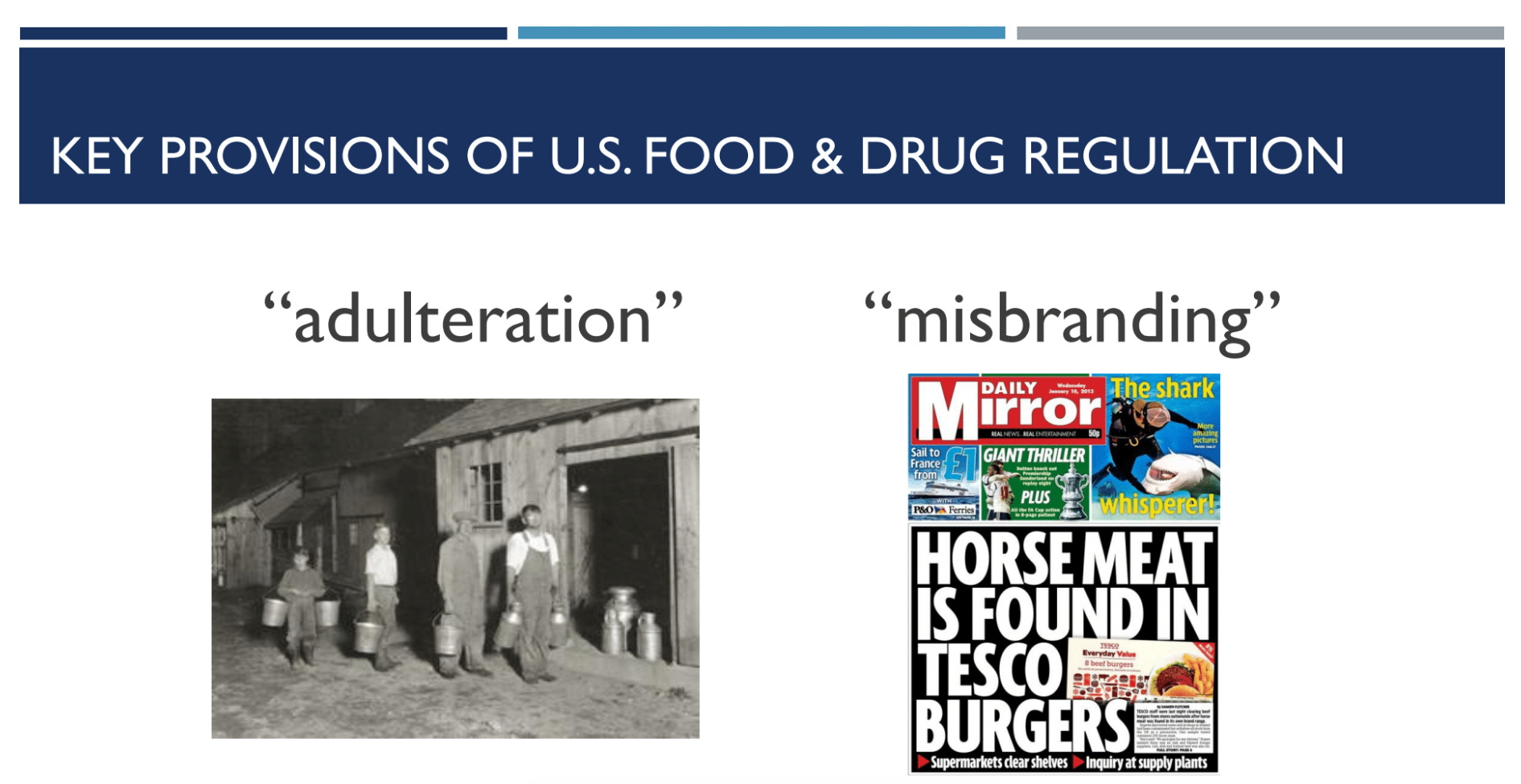
In plain language, “adulteration” is when something is placed in your food that is not supposed to be there - chalk to whiten milk, for one example. A product is “misbranded” when the product is not what it says it is - as in the image above, when consumers are offered horse meat instead of beef. (Sweeney Todd could arguably have been accused of both, given the sanitation practices of Mrs. Lovett)
Adulteration is, first and foremost, about safety. We don’t want illegal or hazardous food additives, mouse droppings, toxic ingredients, melamine, or E. Coli in our food.1 Adulterated food is unsafe food, full stop.2
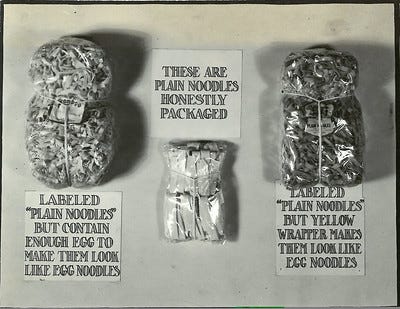
Misbranding, on the other hand, is a little more complex, as it is about fraud, deception, and consumer expectations. The quintessential examples of misbranded items that drove the passage of the 1938 Federal Food, Drug, and Cosmetic Act included products like “strawberry flavored jam,” which contained no strawberries, partially-filled containers, and the use of colored packaging to make products appear more appetizing (such as yellow-tinted packaging to mimic the color of egg noodles.)
While not all food and drug safety violations neatly fit into these categories, at least in a legal sense, these two concepts are the foundation on which the U.S. food and drug regulatory framework has been constructed.
An interesting legal question, then, is when is misbranded food also adulterated? At what point does deception create its own danger to the consumer? Why does it matter that these boxes of Fudgeamentals Chocolate Fudge Bites contain walnuts that aren’t mentioned on the label? [Insert a grumpy libertarian saying it’s fine, let the free market be, consumer choice, etc. etc.]
But of course, this particular type of misbranding has profound food safety implications because walnuts are a common allergen. So, while these “undeclared nuts” pose no hazard for the walnut-consuming public like myself, these fudge bites do pose a serious, even deadly, risk for those who are allergic to tree nuts.
In fact, most, if not all, of the recent “undeclared” recalls in my inbox are recalls of products containing common food allergens:
Undeclared pecans in Boston Baking Mini Cinnamon Crumb Cakes
Undeclared egg in Paw Paw and Harvest Pumpkin Gelato
Undeclared walnuts part 2, this time in Italian wedding cookies
Undeclared cashews in “Craftology This is My Happy Place Pasta Salad”
Undeclared peanut in Hammond’s Candies Salted Caramel Cookies
Undeclared wheat in H-E-B Creamy Creations Light Mint Chocolate Chip Ice Cream
As you may have noticed, many of these products are also baked goods. This raises an important side question for the anti-processed food crowd. At least if we think about processing in terms of “how many steps are needed to create the food item,” baked goods are always going to be pretty high up there. Baked goods are also more likely to contain common food allergens, where other product categories may be able to find ways to remove allergens (removing the risk and potentially attracting new consumers, a capitalist win-win!). What, exactly, should we do about that, if anything?
Finally, lest you think that the concerns about fraud and deception in food are behind us, the FDA recently went after a dietary supplement company that was distributing supplements that contain fewer vitamins than declared on the bottle. These supplements were largely available in discount food stores, which, as I’ve noted elsewhere, is an important reminder that ensuring safe food and drugs is an equity issue.
In other recall news —
Enoki mushrooms are back! Consider continuing not eating and/or being very wary of them! This is not medical advice!
Medical device corner: the Omnipod 5, in a minor recall that affects many of the 37 million Americans who are diabetic, needs a software update. But insulin is free now, so maybe it’s fine.
Since 1996, E. Coli is formally considered an adulterant in U.S. food safety regulation. Salmonella, and many other pathogens, are not. More on that in a future post, probably.
There is a complicated and slightly annoying debate about whether “adulterated” should also equal “unhealthy,” which usually comes up in conversations about fast food.